
Eigenvalue Calculator
An eigenvector of a matrix is a direction that the matrix only stretches, and the eigenvalue is the stretch factor. Enter any square matrix up to 6×6 to get its characteristic polynomial, all eigenvalues — including complex ones — and the eigenvectors, with checks you can follow by hand.
- Free to use
- No sign-up
- Runs in your browser
Eigenvalue calculator
Eigenvalue Practice Pack
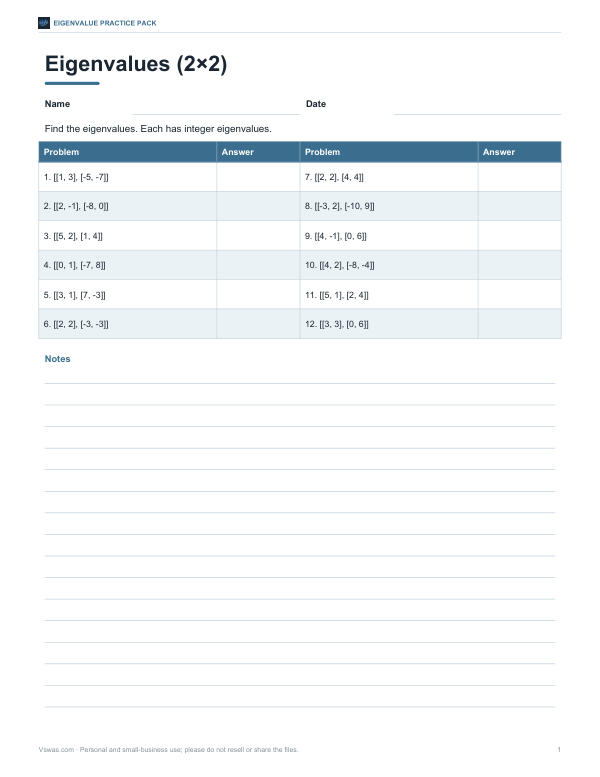
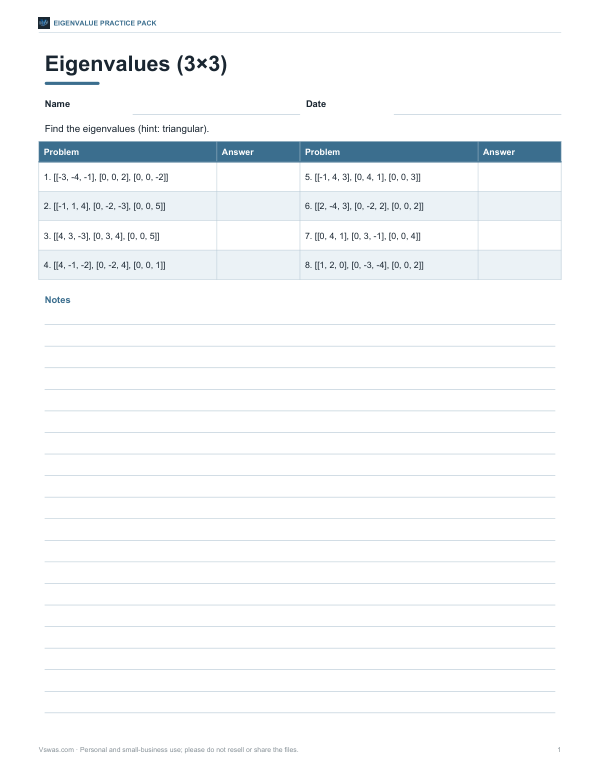
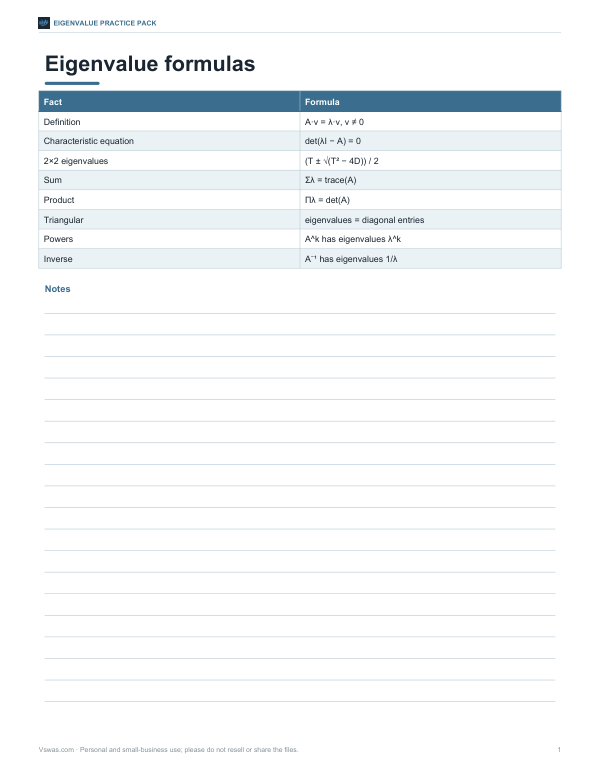
Printable eigenvalue and eigenvector worksheets for 2×2 and 3×3 matrices with worked answer keys, and a linear algebra formula card.
- 2×2 worksheet (PDF/DOCX)
- 3×3 worksheet (PDF/DOCX)
- Formula card (PDF)
Formats: PDF, DOCX. Instant download after payment (link valid 72 hours, up to 5 downloads). AI-assisted: the templates were drafted with AI help and reviewed and laid out before publishing.
$3.00 USD, one-time 3 files · about $1.00 each
- Instant download
- 7-day refund
- Secure checkout by Stripe
7-day money-back guarantee. Full refund within 7 days of purchase, even after you download.
Full refund within 7 days — see the refund policy and license.
Free printables
Single sheets you can print right now, no sign-up. The full pack adds every sheet in one download plus the editable files.
What eigenvalues and eigenvectors are
For a square matrix A, a non-zero vector v is an eigenvector if A·v = λ·v for some number λ, its eigenvalue. Geometrically, A maps v onto the same line through the origin, scaling it by λ (and flipping it if λ is negative). Eigenvalues are the roots of the characteristic polynomial det(λI − A) = 0, which has degree n for an n×n matrix, so there are exactly n eigenvalues counted with multiplicity — some possibly complex.
Worked example: a 2×2 matrix
For A = [[4, 1], [2, 3]], the trace is 7 and the determinant is 4·3 − 1·2 = 10. The characteristic polynomial is λ² − 7λ + 10 = (λ − 5)(λ − 2), so the eigenvalues are 5 and 2. For λ = 5, (A − 5I)v = 0 gives −v₁ + v₂ = 0, so v = (1, 1); check: A·(1, 1) = (5, 5) = 5·(1, 1). For λ = 2, 2v₁ + v₂ = 0, so v = (1, −2) — the calculator scales it to (−0.5, 1). The calculator’s default matrix is this example.
The 2×2 formula
| Quantity | Formula for [[a, b], [c, d]] |
|---|---|
| Trace T | a + d |
| Determinant D | ad − bc |
| Characteristic polynomial | λ² − Tλ + D |
| Eigenvalues | (T ± √(T² − 4D)) / 2 |
| Real and distinct | T² − 4D > 0 |
| Repeated | T² − 4D = 0 |
| Complex pair | T² − 4D < 0 |
For example [[0, −1], [1, 0]] — a 90° rotation — has T = 0 and D = 1, so its eigenvalues are ±i: no real direction is left unchanged by a rotation.
Useful facts for checking answers
- The sum of the eigenvalues equals the trace (sum of the diagonal).
- The product of the eigenvalues equals the determinant.
- A triangular matrix has its diagonal entries as eigenvalues.
- Symmetric real matrices always have real eigenvalues and perpendicular eigenvectors.
- A matrix is invertible exactly when 0 is not an eigenvalue.
- The eigenvalues of A^k are λ^k, and of A⁻¹ are 1/λ.
How the calculator works
The characteristic polynomial is computed exactly from the matrix with the Faddeev–LeVerrier algorithm, and its roots are found numerically with the Durand–Kerner method, which finds real and complex roots together. Eigenvectors are found by row-reducing A − λI and reading off the null space. Results are shown to six decimal places; repeated eigenvalues and nearly defective matrices are numerically sensitive, so very small differences are rounded away.
Algebraic and geometric multiplicity
An eigenvalue that appears more than once as a root of the characteristic polynomial has algebraic multiplicity greater than one. Its geometric multiplicity is the number of independent eigenvectors it has. They can differ: [[2, 1], [0, 2]] has eigenvalue 2 twice but only one eigenvector direction, (1, 0). Such a matrix is called defective and can’t be diagonalised. The identity matrix, by contrast, has eigenvalue 1 repeated with every vector as an eigenvector.
Diagonalisation
- Find all eigenvalues.
- Find a basis of eigenvectors for each.
- If there are n independent eigenvectors, put them as columns of P.
- Then A = P·D·P⁻¹, where D is diagonal with the eigenvalues in the same order.
- Powers become easy: Aᵏ = P·Dᵏ·P⁻¹.
For the worked example, P = [[1, 1], [1, −2]] and D = diag(5, 2).
Eigenvalues of special matrices
| Matrix type | Eigenvalues |
|---|---|
| Identity Iₙ | All equal to 1 |
| Diagonal or triangular | The diagonal entries |
| Rotation by θ (2×2) | cos θ ± i sin θ |
| Reflection (2×2) | 1 and −1 |
| Projection | 0s and 1s |
| Orthogonal | All have absolute value 1 |
| Nilpotent (Aᵏ = 0) | All equal to 0 |
Knowing these patterns is a quick sanity check on any calculator or hand result.
Hand calculation for 3×3 matrices
For a 3×3 matrix the characteristic polynomial is λ³ − (trace)λ² + (sum of the principal 2×2 minors)λ − det. If the matrix has integer entries, try small integer divisors of the determinant as possible roots, then divide the cubic by (λ − root) to leave a quadratic you can solve with the quadratic formula. The calculator gives the polynomial so you can check each step.
Where eigenvalues are used
| Field | Use |
|---|---|
| Differential equations | Solutions of x′ = Ax behave like e^(λt) along eigenvectors |
| Markov chains | The steady state is the eigenvector for eigenvalue 1 |
| Vibrations and structures | Natural frequencies come from eigenvalue problems |
| Principal component analysis | Eigenvectors of the covariance matrix give the main directions of variation |
| Search and networks | Ranking algorithms use the leading eigenvector of a link matrix |
| Quantum mechanics | Measured values are eigenvalues of operators |
Privacy
All calculations run in your browser.
Frequently asked questions
How do I find eigenvalues?
Solve det(λI − A) = 0, the characteristic polynomial.
What are the eigenvalues of a 2×2 matrix?
(trace ± √(trace² − 4·det)) / 2.
Can eigenvalues be complex?
Yes — real matrices can have complex eigenvalues in conjugate pairs.
How do I find an eigenvector?
Solve (A − λI)v = 0 for a non-zero v.
What is the largest matrix supported?
6×6.
Why is my eigenvector different from my textbook?
Eigenvectors can be scaled by any non-zero number; the direction is what matters.
What does a zero eigenvalue mean?
The matrix is singular — it squashes some direction to zero and has no inverse.
Do symmetric matrices always have real eigenvalues?
Yes, real symmetric matrices always have real eigenvalues.
Can I enter decimals?
Yes — any real numbers work.
What is the characteristic polynomial?
det(λI − A), a polynomial in λ whose roots are the eigenvalues.
How accurate are the results?
Shown to six decimal places; repeated eigenvalues can be slightly less precise numerically.
Can I use it for homework?
Yes — use it to check hand calculations; the 2×2 steps show the formula.
Is there a limit on matrix size?
Six by six, which covers most coursework.